0→1 Build
·Artificial Intelligence
Building AnswerThis: One Surface Where Researchers Write, Cite, and Search 300M+ Papers Without Leaving the Draft
AnswerThis — AI research platform · AI Research / Academic Technology
July 26, 2026
·6 min read
AnswerThis is an AI research platform that brings literature discovery, analysis, synthesis, and academic writing into a single workspace. Instead of switching between multiple research tools, researchers can search, review, cite, and write from one interface. Accelate led the frontend and AI integration engineering, building most of the user experience, including the citation and source linking system, the AI drafting and paper editing layer, and the reference retrieval system that pulls papers from the platform's internal library and external academic sources directly into the document as researchers write or search. The platform launched publicly in August 2025 and now searches more than 200 million research papers, summarising up to 20 sources for each literature review. The defining product decision was to make the document, rather than a chatbot, the centre of the research experience.
Paper corpus searched
200M+ papers
Sources summarised per literature review
Up to 20
Research timeline (question to draft)
~2 wks → A few days
The Brief
The founders wanted something that didn't really exist yet: a place where a researcher could go from a blank question to a citation-backed literature review to a publication-ready draft without ever switching tools. The market was full of AI chatbots you could ask about papers, and separate reference managers, and separate writing apps. AnswerThis was meant to be the connective tissue discover, analyse, synthesise, and write in one continuous loop, with citations that a peer reviewer would actually trust.
The audience made the bar high. PhD students, professors, doctors, and industry researchers don't forgive hand-wavy citations. If the tool surfaced a claim it couldn't trace back to a real source, the whole thing was worthless to them.
The Constraints
- It had to feel like a writing tool, not a chat window. Researchers spend their day inside documents. A sidebar you copy-paste out of would break flow and lose to Word.
- Citations had to be verifiable, not decorative. Every claim needed to link back to a real, retrievable source. Academic integrity isn't a feature here, it's the product.
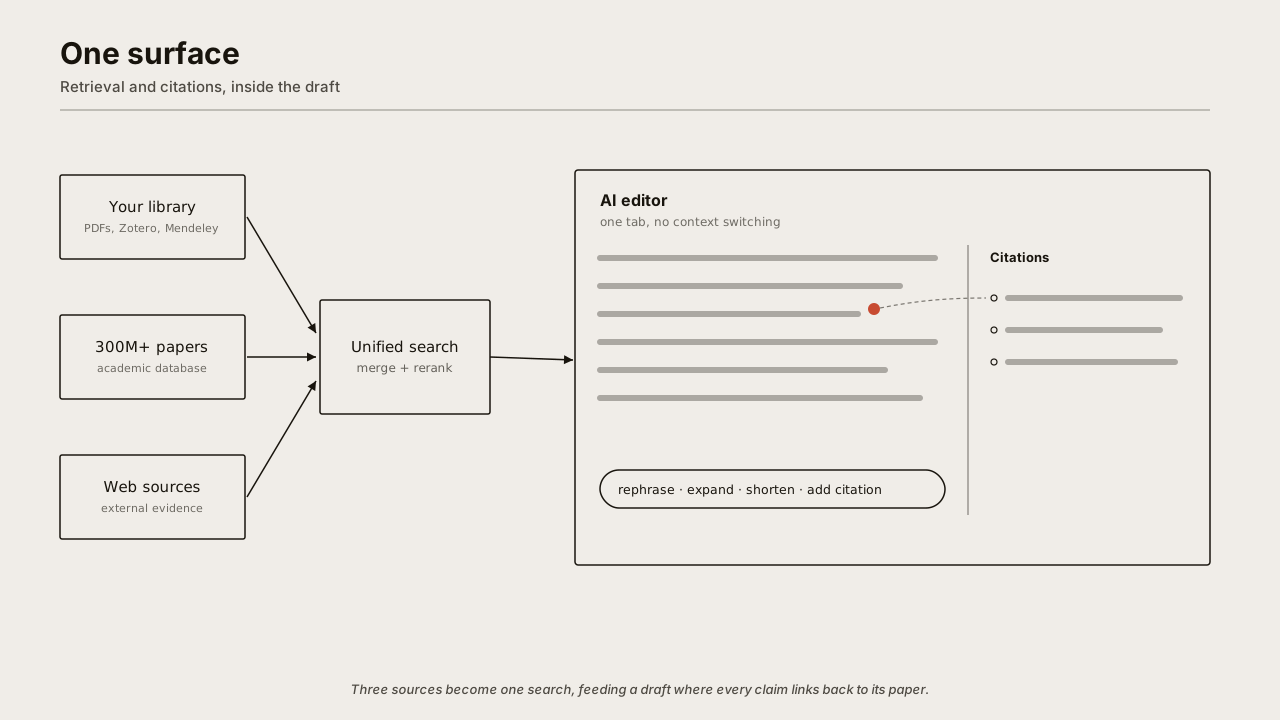
- Retrieval had to span three worlds at once: the user's own uploaded library, the platform's 200M+ paper academic database, and the open web deduplicated and ranked into one coherent list.
- It had to keep the researcher in flow. Searching for a supporting paper couldn't mean leaving the draft.
Key Decisions
1. Editor-first, not chat-first. The biggest fork was where research actually happens. We built the home surface as a Notion-style rich-text editor rather than a chat thread. Research happens inside the document you draft, and the tools (search, citation, rewrite) come to you. This was the decision that separated the product from every "chat with your PDF" competitor, and it drove most of the UI complexity: inline citations, editable AI output, and search results that land in the draft rather than in a separate pane.
2. Citations as first-class objects. Rather than appending a reference list at the end, every generated claim carries its source with it. The source-linking system ties each summary back to the original paper, and every claim in a generated review carries a line-by-line citation back to its source paper, so a researcher can verify it without breaking stride. This was the single most-engineered part of the interface, because it's the part that earns trust.
3. Unified retrieval, callable mid-draft. One search spans the user's stored library, the internal academic database, and external sources merged, deduplicated, and ranked into a single result set the writer can pull from without leaving the page. The hard part wasn't any one source; it was making three very different sources feel like one, fast enough that searching mid-sentence didn't feel like a context switch.
4. The one I'd reconsider. The AI writing layer shipped deliberately light. Rephrase, expand, outline, and custom-prompt edits on selected text, while most of the engineering weight went into retrieval and citations. That was the right call for launch, but it's the part I'd invest in earlier next time: tightening the coupling between the writer and the citation system so that generated prose automatically carries its sources, the same way manually-cited text does. Independent reviewers have flagged the writer as lighter than dedicated writing tools, and I think that gap traces straight back to this sequencing choice.
What Shipped
A single platform covering the research lifecycle end to end:
| Layer | What it does |
|---|---|
| Editor | Notion-style rich-text writing surface; the home base for all research |
| Literature review | Generates structured, citation-backed reviews from a research question across 300M+ papers |
| Retrieval | Unified search across the user's library, the internal academic DB, and external sources |
| Citations | Source-linking, line-by-line citations tied to source papers, citation mapping |
| AI writer | Rephrase / expand / outline / custom-prompt editing on any selected text |
| Library | Per-project organisation of papers and sources |
Stack (Accelate's layers): React.js, TypeScript, OpenAI APIs and LLMs, vector embeddings for retrieval, plus the custom citation/source-linking and rich-text editor systems.
Outcome
AnswerThis launched publicly in August 2025 and is positioned for PhD students, professors, doctors, and consultants, including healthcare and corporate research teams. It searches over 300 million research papers, generates literature reviews with line-by-line citations linked to the original paper, and ships free, Pro, and Institutional tiers to a base of over 200,000 researchers and institutions. Independent reviewers have described real research timelines compressing from roughly two weeks to a few days using the review-plus-writer workflow.
When This Approach Doesn't Apply
The editor-first bet only pays off when writing is the actual job. If the goal is quick Q&A over a handful of PDFs, a full document platform is overkill. A chat interface is simpler and faster to build. The complexity we took on (inline citations, mid-draft retrieval, an editable AI layer) is only worth it when the user's real output is a long, cited, defensible document. For lightweight lookup, it's the wrong architecture.
FAQ
What exactly did Accelate build?
Most of the user interface, the citation and source-linking system, the drafting and paper-editing tools, and the reference retrieval that fetches papers from the internal store and external sources into the document. The platform's core paper corpus and infrastructure sit with the AnswerThis team; Accelate built the layers researchers touch.
Why an editor instead of a chatbot?
Because researchers live in documents. Putting the tools inside the writing surface rather than in a chat you copy out of and keeps people in flow and makes the product a place to work, not just to ask questions.
How are citations kept trustworthy?
Every claim links back to a real, retrievable source through the source-linking system, with inline summaries of up to 20 sources per review. Verification happens in-place, which is the whole point for an academic audience.
How does search work while writing?
One unified search spans the user's library, the internal academic database, and external sources, merged and ranked into a single result set that lands directly in the draft, no tab-switching.
What's the honest weak spot?
The AI writer is intentionally lighter than the retrieval and citation layers. It's strong at rephrasing and restructuring; it's not a full generative drafting engine, and tighter writer-to-citation coupling is the first thing worth deepening.
What we’d do differently
The AI writing layer shipped deliberately light rephrase, expand, outline, and custom-prompt edits on selected text, while most of the engineering weight went into retrieval and citations. That was the right call for launch, but it's the part I'd invest in earlier next time: tightening the coupling between the writer and the citation system so that generated prose automatically carries its sources, the same way manually-cited text does. Independent reviewers have flagged the writer as lighter than dedicated writing tools, and I think that gap traces straight back to this sequencing choice.